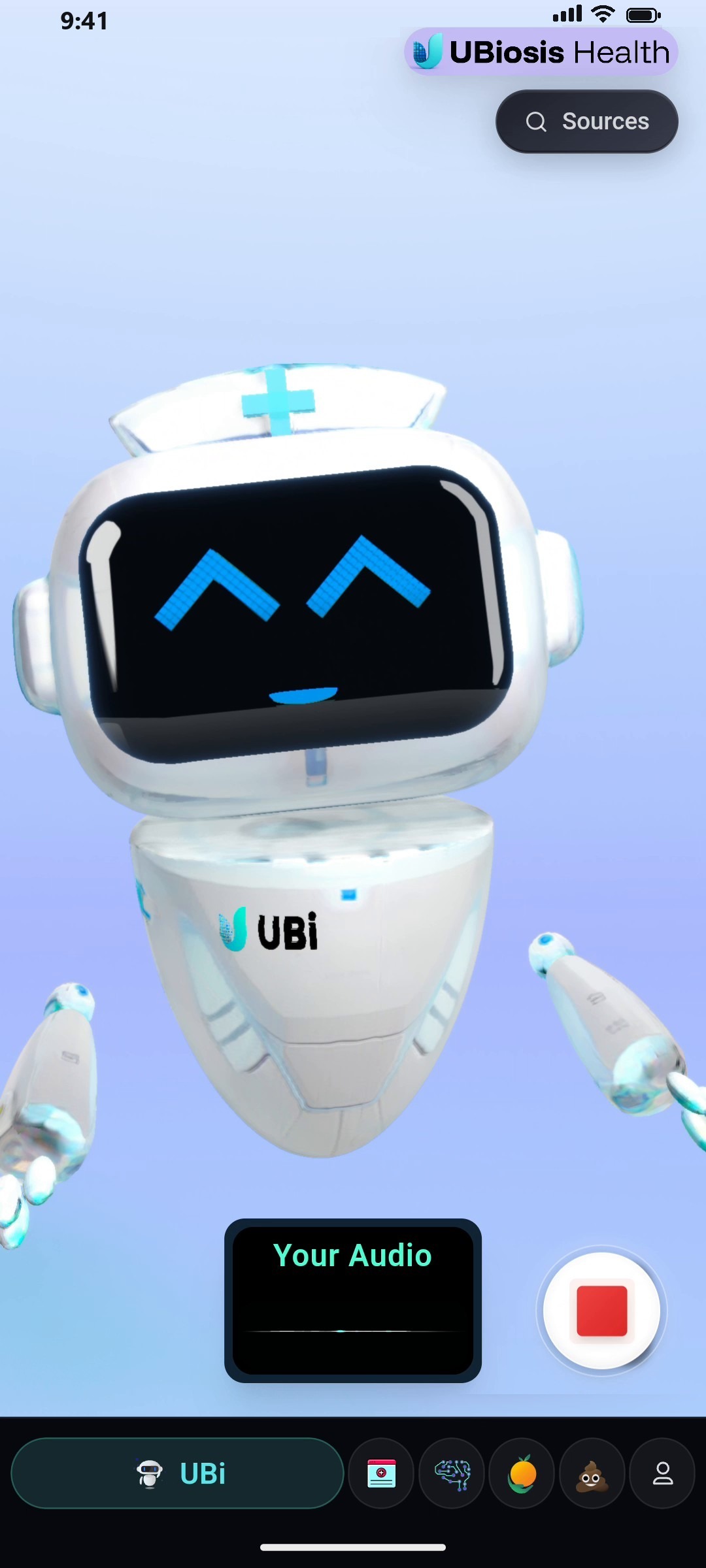
Meet UBi,the AI nurse on your care team who supports your GI patients every day.
She takes on the routine work between visits and pre-emptively checks their biomarkers, lowering your administrative burden while improving clinical outcomes at scale.She handles their routine questions and pre-emptively checks their biomarkers, so your office takes fewer calls and you can adjust treatment earlier to improve clinical outcomes at scale.
UBi helps you understand if your patients’ treatments are truly working for them.
Through daily conversations, UBi connects the changes patients are feeling with objective changes in their gut’s biology.
Symptoms can settle while the gut is still inflamed. UBi follows each patient every day between visits, so you see what symptoms alone would miss.
Daily check-ins on symptoms, diet and medication
Calprotectin tracked against each patient’s own target
Failing treatments flagged to you months before standard care would notice
01For the patient
Care that stays with patients between visits.
UBi provides daily conversations, nutrition guidance and practical support.
02Built around individual biology
A care plan that evolves with the patient.
Our nurses review each patient’s results and care history to help their GI decide whether treatment needs to change.
Gut inflammation (calprotectin)
Her target rangeTreatment adjustedHer GI changes treatment at the peak of inflammationFlagged by UBi and our nursesYou adjust treatmentSymptoms goneClinical remission: symptoms gone, gut still inflamedBack in rangeObjective remission: inflammation back on target
StartMonth 3Month 6
03Alongside their own GI
A clearer basis for earlier decisions.
Failing treatments are flagged to you months before standard care would notice.
UBi’s pre-emptive, biomarker-driven care proves treatments are actually working and escalates failing ones months before the standard of care would notice.
Similarly designed IBD treat-to-target programs have shown
A personalized AI nurse who gets to know each patient every day.
Through daily conversations, nutrition guidance and support through the hard days, UBi learns how each patient lives and feels.
Support every day, so patients never manage this on their own.
Patients talk with UBi about food, meds, questions and the bad days, by voice or text at any hour, and she turns what they share into structured clinical information for their doctor.
Understand the biology behind the daily experience.
UBi connects biomarker testing with symptoms, treatment, nutrition and wearable trends to understand how each patient’s individual biology responds to care.
Biomarkers and daily signals
Symptoms
Intervention plannedMonth 1.5
StartMonth 3Month 6
UBiConnecting biomarkers and daily signals
Toward deep remission
42/100
GI Health Score
Moving away from targetWorsening signals prompt clinical review
StartMonth 3Month 6
○Clinical remissionTracking
○Biomarker responseTracking
○Endoscopic healingTo confirm
Treatment response, measured over time.
UBi helps improve clinical outcomes while lowering the administrative burden on GI practices.
Getting started takes no lengthy EMR integration.
The practice refers patients, and UBi takes care of their enrollment and first conversation.
Biomarker responseRead against the treatment target
UBi answers the routine questions and catches the silent non-responders.
Patients get answers from UBi and the UBiosis team instead of calling the front desk. She flags the patients whose treatment has quietly stopped working before they end up in the ER.
Nurse reviewReviewed ✓
Biomarker trend reviewed
Current therapy confirmed
Recommendation prepared for the GI
Every result is filed in the practice’s EMR as structured data.
Conversations, symptoms and test results arrive in the chart where the care team already works.
Patient briefNursing team reviewed · ready for GI
Review the patient’s biomarker trends, daily experience and current treatment together.
Continue planInvestigateAdjust treatment
UBi compiles the data that supports prior authorizations.
She gathers the biomarker history and records an insurer asks for, and the office submits the request with that support already in hand.
Prior authorizationApproved ✓
Drafted
Submitted
Approved
UBi schedules follow-ups and gets patients ready for colonoscopy.
She walks each patient through the prep on the right days and confirms they are ready the morning before the procedure.
An IBD care pathway, with the patient’s own gastroenterologist directing treatment.
Your GI practice
New patient referralElena M.Ulcerative colitis · on vedolizumab
Phone(713) 555-0142Standing ordersOn file
Refer to UBi
Enrollment
Referral received9:02 AM
Consent signed in the app9:14 AM
First conversation with UBi9:20 AM
Started the same morning, with nothing to install
Patient messages this week handled by UBi
Can I have pizza at a party on Saturday?
Thu 9:41 PMAnswered by UBi
I missed my injection this morning. What should I do?
Fri 11:08 PMAnswered by UBi
Still going 6 or 7 times a day. Is that normal on Humira?
His message triggered a review. Our nurse checks his full record today before anything goes to his GI.
Today’s check-in with UBi
Patient chart · Elena M.
Measure
Value
Source
Symptom score (PRO2)
2 / 6
UBi
Stool frequency
3 a day
UBi
Rectal bleeding
None
UBi
Fecal calprotectin
142 µg/g
Lab via UBi
Medication adherence
96%
UBi
Weight
68.4 kg
UBi
Encounter note · filed by UBi
Prior authorization support · James K.
Treatment change: dose increase4 of 4 sections
Calprotectin history
180 → 310 → 520 → 690 µg/gTreatment history
Mesalamine · 2023 to 2024 · inadequate response
Adalimumab · 2024 to now · loss of response
Symptom record · 90 days
Visit notes and nurse review
Compiled by UBi from the chart and her recordHand off to the office
The office submits the request with this support attached
9:41
Colonoscopy prepThursday, Oct 23 · 8:00 AM
7 days beforePause iron supplements
3 days beforeSwitch to low-fiber foods
Day beforeClear liquids, first dose at 6 PM
Morning ofSecond dose at 3 AM
Your second dose is done. What does it look like now?
Clear and light yellow
That means you’re ready. Your ride should leave by 7:15 for your 8:00 check-in.
Ready for the procedureConfirmed with the patient at 6:40 AM
Scheduled by UBi
Oct 23Colonoscopy8:00 AM
Nov 13Follow-up visit10:30 AM
Built on real clinical evidence, condition by condition.
Pick a condition to see the trials behind the way UBi works, what they showed, where UBi carries each step between visits, and what that does to the cost of care.
Treat-to-target care, carried all the way to a healed scope, is what makes deep remission real.
Deep remission, meaning symptoms, scope and steroids all clear, is the goal that changes the course of IBD. Care that keeps checking every day gets more people there and keeps them there, at a fraction of what it costs today to get one person well.
58%in deep remission at two years, against 23% with usual care23
81%lower risk of strictures, fistulas, hospital stays and surgery for every patient UBi gets into deep remission, 58% of patients by year two and 69% by year three8
−72%cost to get one person fully well on today’s biologics, about $700K down to about $197K4
$24Kless spent per person on the strongest medicines over three years22
Patients in deep remissionclinical, endoscopic and steroid-free remission together
Usual care
UBi, central case
IBDCrohn’s disease and ulcerative colitis, the evidence
The trial results describe the clinical approach UBi runs under the patient’s own GI, not a UBi trial; the treatment decisions in every study were the physician’s. Economics are modeled from published trials, claims studies and national rates, shown as the central case with the range in the sources.
Treat-to-target care, carried all the way to a healed scope, is what makes deep remission real.
1Clinical responseSymptom scores down by half within weeksUBiDaily check-ins turn how the patient feels into a scored symptom record (PRO2).
2Clinical and biomarker remissionSymptoms in remission, CRP normal, calprotectin 100–250 µg/gUBiCalprotectin on a set schedule, or sooner when the trends call for it, read against the patient’s own target and reviewed by our nurses.
3Endoscopic healingNo ulcers on the follow-up scopeUBiUBi gets the patient to the confirming colonoscopy, through the prep, and files the result in the chart.
4Deep remissionClinical, endoscopic and steroid-free remission togetherUBiThe GI decides each treatment step with the full record and a nurse-reviewed brief.
$23Ka year in direct costs per IBD patient, against $7K for a matched patient without IBD1
47%of Crohn’s patients and 16% of UC patients reach surgery within 10 years of diagnosis2
11%of Crohn’s patients get proactive monitoring in the first six months on a biologic3
$205K–$788Kof drug spend per clinical remission at 52 weeks in moderate-to-severe UC, by drug4
Clinical and biomarker remission
Escalating on biomarkers and symptoms, not symptoms alone, heals more patients.
46%mucosal healing at week 48, against 30% with symptom-led care
Mucosal healing at week 48, early Crohn’s disease (CALM)
Escalated on calprotectin, CRP and symptoms46%
Escalated on symptoms alone30%
In CALM, therapy was stepped up when calprotectin reached 250 µg/g, CRP 5 mg/L or symptoms rose, rather than on symptoms alone. Mucosal healing at 48 weeks went from 30% to 46%, a 16-point difference.5
UBiUBi runs the monitoring half of that loop, so the GI’s escalation decisions get made on time.
Biomarker remission
A normal calprotectin tells us who can wait for the scope, and who cannot.
97%negative predictive value of calprotectin ≤250 µg/g for endoscopic remission in Crohn’s
Calprotectin against endoscopy, 19 studies, 2,499 patients
Sensitivity for active disease88%
Specificity73%
Across 19 studies calprotectin found active inflammation with 88% sensitivity and 73% specificity against endoscopy. A value at or under 250 µg/g ruled out active ulcers with a 96.6% negative predictive value.6
UBiScheduled calprotectin tells us whom to send for the scope sooner. It never stands in for it.
Endoscopic healing
Patients whose mucosa heals have fewer surgeries and admissions.
66%fewer major abdominal surgeries with mucosal healing (RR 0.34)
Relative risk with mucosal healing, 19 studies, Crohn’s and UC
Major abdominal surgeryRR 0.34
HospitalizationRR 0.58
In a pooled analysis of 19 studies, mucosal healing predicted fewer major surgeries (RR 0.34) and fewer hospitalizations (RR 0.58), with the same pattern in Crohn’s and UC.7
UBiThe scope is where healing gets confirmed. UBi makes sure it happens and that the patient arrives prepared.
Deep remission
Deep remission at one year protects against the disease progressing.
0.19adjusted hazard of progression for patients in deep remission at one year
Progression over a median 3 years, CALM follow-up (122 patients)
Deep remission at one yearHR 0.19
Not in deep remissionHR 1.00
Patients in deep remission at the end of CALM (clinical remission, no ulcers on scope, no steroids) had a far lower risk of new strictures, fistulas, hospitalization or surgery over the next three years, whichever arm they had been in.8
UBiThat is why UBi works toward the confirming endoscopy and not just a quiet patient.
What programs built this way have measured
Each of these put a nurse or a daily check-in between the patient and the GI. Every one of them cut unplanned care; the savings tracked engagement, and engagement is what UBi is built for.
SonarMDBCBS Illinois, 152 Crohn’s patients, year before vs year after
−57%inpatient payments; ER −53%
Net 9.87% savings after the program fee, over $1,000 per patient. Engagement went from 27% to 75–80% once check-ins moved to text, and the savings tracked the engaged patients.12
UPMC Total Care-IBD322 patients in a specialty medical home, year before vs year after
−47%emergency visits; hospitalizations −36%
Disease activity scores and quality of life also improved. Patients on steroids or opioids at enrollment were the ones who kept coming back, which is who a daily check-in is for.9
myIBDcoachRandomized, 909 patients, Netherlands
½the hospital admissions (0.05 vs 0.10 per patient)
A telemonitoring app with nurse follow-up cut admissions in half and outpatient visits by a third (1.55 vs 2.34 a year) with the same quality-of-care scores.13
14 randomized trialsE-health IBD care, 3,111 patients, pooled
Across every randomized e-health trial in IBD, patients went to the emergency department less and to the office less, with no loss of disease control.14
Oshi Health234 patients vs matched controls, virtual GI clinic
$8,112a year lower all-cause cost per patient
GI emergency visits 4% vs 10%, imaging 15% vs 44%. Mostly IBS and other gut-brain disorders; the IBD subgroup trended the same way.15
Where the cost of care moves
Tight control on its own moves spend from the hospital to the pharmacy: in CALM, Crohn’s hospitalizations fell 58% while adalimumab use rose 26%. The savings arrive when the drug side is managed with the same discipline, and every lever below has been shown in its own study. Values are our model per patient on advanced therapy, a year, central and optimistic.
CentralOptimistic
ER visits and admissions avoided
Anchored to the randomized trials (about 17% of unplanned-care spend), below what SonarMD and UPMC measured.14
$2,700$6,000
Futile dose escalations avoided
Checking drug levels at loss of response cut infliximab escalations from 71% to 45% with the same response rate and 15% lower cost; in a randomized trial the level-guided path cost 34% less than dose intensification, again with the same response.16
In TAXIT, 93% of patients above the target trough were dose-reduced to range, cutting drug cost 28%, and concentration-based dosing had fewer flares (7% vs 17%).10
$2,160$5,250
Biosimilar switch confirmed effective
With a nurse present at the switch, 91.8% of patients accepted an adalimumab biosimilar and 90.4% kept clinical remission at 12 months. The adalimumab gap runs about $19K a year at net prices.17
$1,500$4,000
Infusions moved out of the hospital outpatient department
Across 52,760 infusions, hospital outpatient departments cost 41.9% more with no difference in adverse events, admissions or ER visits.18
$2,000$5,000
Tests, and the escalations monitoring itself triggers
Calprotectin at $30 to $60 a test, and the earlier escalations tight control brings (CALM +26% adalimumab, SonarMD +9% infusibles).19
−$500−$300
Per patient on advanced therapy, a year
About $3,350 averaged across a whole IBD panel, where 28% of patients are on advanced therapy.22
$8,900$22,200
For patients on conventional therapy the value is biologic starts averted when monitoring proves the current treatment is working, about $5,000 a year for the patient with a flare or steroid course in the past year: 87.5% of patients with a normal calprotectin and no change in therapy stayed in remission over the next three months, steroid courses grow from 34 to 88 days a year across the five years before a biologic start, and non-adherent patients in remission relapse 5.5 times as often.21
In silico: what the stack adds up to over three years
A simulated panel of 1,000 IBD patients, usual care against UBi, month by month for 36 months, built by chaining the studies above: CALM sets the deep remission reached in year one, TAXIT sets how many remitters relapse each year on symptom-led versus level-guided dosing, the CALM follow-up sets how much less often patients in deep remission progress, and the lever model sets the cost. The line is the central case; where there is a band it reaches the optimistic case.
7patients on UBi to put one more in deep remission at one year37% against 23% (CALM)23
7to keep one more in deep remission through year twosustained 34% against 19%; in deep remission at two years 58% against 23%10
−46%major adverse outcomes across the panel at three years, as more patients reach the 81% lower risk of deep remission11.4 against 21.1 per 100 patient-years; 61% lower once 84% of patients are in deep remission8
−65%cost per remission on advanced therapyabout $700K per remission on today’s biologics to about $243K at two years; −75% in the optimistic case4
Usual care
UBi, central case
to the optimistic case
Patients in deep remissionclinical, endoscopic and steroid-free remission together
Year one is CALM: 36.9% against 23.0%. After that UBi keeps the loop running: patients not yet in deep remission keep converting at the same rate while remitters relapse at 7% a year on level-guided dosing. Usual care holds where it is, which is what IBD Qorus measured across 41 practices. At two years 58% against 23%; at three 69%.23
The path to 81% fewer adverse outcomesstrictures, fistulas, admissions and surgery per 100 patient-years
A patient outside deep remission has about 26 major adverse outcomes per 100 patient-years; in deep remission, 4.9, 81% lower (Ungaro). As UBi brings more of the panel into deep remission and keeps them there, the panel’s rate falls: 14% below usual care at one year, 34% at two, 46% at three, and 61% once 84% of patients are in deep remission. Usual care’s level is what REACT measured in 39 community practices, 35.1% with a major adverse outcome by two years.8
Cost of careper patient per year, whole panel
$33,000 a year falls to $29,649 (central) and $25,151 (optimistic) once every lever is running. Over three years that is $8,831 to $20,685 saved per patient across the panel, and $23,550 to $58,506 per patient on advanced therapy.22
Cost per remissiondrug spend per patient in deep remission, advanced therapy
Today’s biologics run about $700K per remission at list price (adalimumab $750K, ustekinumab $788K). It compounds: the same drug dollars buy 2.5 times the deep remissions at two years and 3.0 at three, and the de-escalation and switch levers grow with the remission pool, taking 13% then 15% off spend. Cost per remission falls to about $243K at two years (−65%) and $197K at three (−72%); $133K in the optimistic case.4
Simulation inputs: deep remission at 48 weeks 23.0% vs 36.9% (CALM, posted trial results); relapse out of remission 17% vs 7% a year (TAXIT, clinical vs concentration-based dosing); HR 0.19 for major adverse outcomes in deep remission (Ungaro) with the real-world level set by REACT’s conventional arm, 35.1% at 24 months, giving an annual hazard of 26% outside deep remission and 4.9% inside it; $33,000 a year per patient (Park, 2026 dollars); whole-panel savings $3,351 central and $7,849 optimistic per patient-year from the lever model, realized 25% by month 3, 75% by month 6 and fully from month 12; cost per remission from $700K on today’s biologics (Jairath), divided by the deep-remission ratio, with the drug levers growing with the remission pool (15% to 43% of drug spend by year three). Usual care reaches CALM’s conventional-arm deep remission in year one and holds there (IBD Qorus: site-level remission unchanged across 41 practices); if it instead kept converting at the trial rate, cost per remission would still be 45% lower at three years. UBi has no outcomes data of its own yet; this is the projection the studies support, and the one our first-practice data will be measured against.
The IBS care the guidelines call for, delivered every day: the right diagnosis, the diet done properly, and a next step when symptoms don’t settle.
IBS costs twice what a matched patient costs, and almost all of it is scans, scopes and emergency visits rather than the IBS itself. The care that works is a diet done with a dietitian, the right first medicines and gut-directed therapy, and it works when someone is there every day.
66%of people got meaningfully better with integrated care, against 38% with the GI alone5
4%needed a GI emergency visit in a year, against 10% in usual care4
1 in 4people improve on peppermint oil or gut-directed therapy, one in seven on soluble fiber7
$1,889saved per person a year, after the program’s price, in an independent assessment
IBSIrritable bowel syndrome, the evidence
The trial results describe the clinical approach UBi runs under the patient’s own GI, not a UBi trial; the treatment decisions in every study were the physician’s. Economics are modeled from published trials, claims studies and national rates, shown as the central case with the range in the sources.
The IBS care the guidelines call for, delivered every day: the right diagnosis, the diet done properly, and a next step when symptoms don’t settle.
1The right diagnosisInflammation and celiac ruled out, subtype known, no colonoscopy under 45 without alarm featuresUBiEveryone gets the stool test; calprotectin, CRP and celiac serology for IBS-D as ACG asks; the subtype comes from the stool logs, not a guess.
2Adequate reliefThe patient reports relief in most weeksUBiA daily diary of stool form, pain and bloating, and the weekly adequate-relief question, by voice or text.
3Symptom responseIBS severity score down by 50 points or moreUBiLow-FODMAP in all three phases with reintroduction, soluble fiber, peppermint oil, and the gut-brain options the guideline supports, with the GI deciding the drugs.
4Fewer scans, scopes and ER tripsCare that stays in the practice instead of the emergency roomUBiUBi escalates when symptoms don’t settle, so the next step is a GI decision rather than an ER visit.
6.1%of US adults meet Rome IV criteria for IBS; most of them have sought care in the past year1
$13.3Kmedian all-cause cost per IBS patient a year, against $6.0K for a matched patient; only $1.1K of it is coded to IBS2
78%of the extra cost is medical (visits, scans, scopes, the ER), not pharmacy3
44%of IBS patients in usual care had imaging in a year, and 10% a GI-related emergency visit4
Symptom response
Integrated dietitian, psychology and GI care beats the gastroenterologist alone.
66%severity response with integrated care, against 38% with GI-only care
In a randomized trial of integrated care (gastroenterologist, dietitians, gut-focused psychology) against GI-only care, global improvement was 84% versus 57% and the IBS subgroup’s severity response 66% versus 38%. Single centre, in person, open-label.5
UBiThis is the care model UBi delivers between visits, with the practice’s GI directing it.
Fewer scans, scopes and ER trips
A virtual multidisciplinary program kept patients out of the scanner and the ER.
4%GI-related emergency visits in the program, against 10% of matched controls
Propensity-matched claims, 234 patients, mostly IBS and other DGBI (Oshi)
Imaging: program 15% vs controls 44%15% vs 44%
GI-related ER visits: program 4% vs controls 10%4% vs 10%
IBS severity fell from 227 to 146 among engaged patients, and GI-related cost was $5,316 a year lower than matched controls. Observational, from a comparable program rather than UBi.4
UBiDaily contact is what catches the bad week before it becomes a scan or an ER visit.
Symptom response
Low-FODMAP works when all three phases get done.
57%satisfactory relief long term after dietitian-led low-FODMAP with reintroduction, from 12% at baseline
Satisfactory relief, dietitian-led low-FODMAP with reintroduction (uncontrolled, 103 patients)
Long term, on an adapted diet57%
Baseline12%
Low-FODMAP ranked first among diets in a network meta-analysis of 13 trials (RR 0.67 for symptoms not improving), and ACG says all three phases must be taught. Most trials never studied reintroduction, which is where patients get stuck on their own.6
UBiUBi runs the restriction, reintroduction and personalization phases meal by meal, and knows which foods came back.
The right diagnosis
The guideline’s first steps have small numbers needed to treat.
4treated for one to improve with peppermint oil or gut-directed psychotherapy; 7 with soluble fiber
Number needed to treat for global symptom improvement
Peppermint oil (NNT 4)1 in 4
Soluble fiber (NNT 7)1 in 7
Soluble fiber carries a strong ACG recommendation (NNT 7, moderate quality); peppermint oil and gut-directed psychotherapy are conditional with low-quality evidence (NNT 4). For IBS-D, rifaximin gave adequate relief in 41% versus 32%; for IBS-C, linaclotide met the FDA endpoint in 34% versus 14%.7
UBiUBi delivers the first-line steps every day and tracks the response, so the GI escalates to a drug on data.
Reflux care the way the guidelines say: a proper trial of the acid blocker, a step down when it works, and a test before any escalation when it doesn’t.
Half the people on a daily PPI, the standard acid blocker, still get reflux twice a week, and when they are referred as refractory, meaning the drug isn’t working, four in five turn out to have a dose, timing or diagnosis problem instead.
78 of 366people referred as refractory actually were; the rest had a fixable cause5
2×as many long-term users halved their PPI within a year with a step-down program6
5.8%stopped their medicine on an as-needed PPI, against 11% on a daily one8
$2,183saved per person a year by testing before escalating
GERDReflux disease, the evidence
The trial results describe the clinical approach UBi runs under the patient’s own GI, not a UBi trial; the treatment decisions in every study were the physician’s. Economics are modeled from published trials, claims studies and national rates, shown as the central case with the range in the sources.
Reflux care the way the guidelines say: a proper trial of the acid blocker, a step down when it works, and a test before any escalation when it doesn’t.
1Symptom responseHeartburn controlled on an 8-week once-daily PPI trialUBiUBi coaches the dose 30 to 60 minutes before a meal and tracks symptoms every week of the trial.
2Step-downOff the PPI, or on the lowest dose that holds, once symptoms respondUBiUBi runs the step-down the guideline asks for and catches a relapse early.
3Test, don’t escalateNon-responders get endoscopy off PPI and reflux monitoring, not a second drugUBiUBi flags non-response at week 8, so the workup gets scheduled instead of another prescription.
4The right endoscopyHealing confirmed where esophagitis is severe; Barrett’s screened once where risk factors stack upUBiUBi screens for alarm features and risk factors, and gets the eligible patients scoped and prepared.
54%of people on a daily PPI still have reflux symptoms at least twice a week1
16%of initial endoscopies for GERD were low-value, three-quarters of them from two GI clinics2
39%of patients eligible for Barrett’s screening had ever had the endoscopy3
253Kemergency visits a year with GERD as the principal diagnosis4
Test, don’t escalate
Most “PPI-refractory” heartburn isn’t refractory reflux.
78of 366 patients referred for PPI-refractory heartburn had truly refractory, reflux-related disease after a full workup
What the workup found, VA referrals for PPI-refractory heartburn
Truly refractory, reflux-related (78)21%
Functional heartburn (99)27%
Of 366 patients, 42 were relieved by two weeks of twice-daily omeprazole, 99 had functional heartburn and 23 had another esophageal disorder. Only 78 had reflux disease that was truly refractory.5
UBiThe guideline says test first and stop the PPI if testing is negative. UBi gets non-responders to that workup.
Step-down
Long-term PPI users can step down without their symptoms getting worse.
14.9%of long-term users halved their PPI within a year with a deprescribing program, against 7.0% with usual care
Halved the annual PPI dose at one year, cluster RCT, 34,409 patients
Deprescribing intervention14.9%
Usual care7.0%
A mailed brochure and a letter to the GP doubled the share of long-term users who cut their dose in half, with no difference in reflux-impact scores.6
UBiThat was a one-letter intervention. UBi stays with the patient through every step down and catches the ones who relapse.
Step-down
A nurse-led step-down program moved three in four patients down or off.
75%of 6,249 long-term PPI users had stepped down or off at 12 months
Status at 12 months, UK nurse-led program (uncontrolled)
Off the PPI40.3%
On a lower dose34.8%
One 20-minute visit with a trained nurse, an action plan and rescue therapy. 8.7% went back to their original dose. The study had no control group and the authors were affiliated with the rescue-therapy maker.7
UBiThe closest published analog to UBi’s step-down coaching, with its caveats shown.
The right endoscopy
On-demand dosing cuts the pill burden for patients without erosive disease.
5.8%stopped treatment on on-demand PPI, against 11.0% on daily PPI, across 10 trials
Discontinuation, on-demand vs daily PPI, 10 RCTs, 4,574 patients
On-demand5.8%
Daily11.0%
On-demand use takes 3.8 fewer pills a week; it also leaves more breakthrough symptoms, so it suits non-erosive disease, which is where the guideline suggests it.8
UBiUBi knows which patients have erosive disease on file and keeps them on maintenance, and moves the rest to on-demand.
GLP-1 stewardship: get people through the dose ramp, measure the response, and stop the drug when it isn’t working.
Two in three people quit a GLP-1 in the first year, most of them during titration, the dose ramp where the nausea peaks. Daily support gets them through it, and a measured weight tells the prescriber whether to continue or stop.
2%stopped for stomach side effects with a flexible dose ramp, against 19% on the label schedule5
−11.9%body weight at one year for people who stayed on, against −3.6% for those who stopped early6
65%of people without diabetes stop within a year today2
3.8%of GLP-1 spend avoidable by stopping the people the drug isn’t working for
GLP-1GLP-1 stewardship, the evidence
The trial results describe the clinical approach UBi runs under the patient’s own GI, not a UBi trial; the treatment decisions in every study were the physician’s. Economics are modeled from published trials, claims studies and national rates, shown as the central case with the range in the sources.
GLP-1 stewardship: get people through the dose ramp, measure the response, and stop the drug when it isn’t working.
1Tolerated titrationThrough the dose steps to a maintenance dose, with side effects managedUBiDaily side-effect coaching, and a slower step when nausea or vomiting flare, as the labels allow.
2ResponseAt least 5% weight loss after about 3 months on the maintenance doseUBiMeasured weights from a cellular scale, so the response verdict is documented, not estimated.
3Full benefit10 to 15% weight loss and still on treatment at 12 monthsUBiUBi keeps patients on through the dips and shows them their own measured progress.
4Stop or switch non-respondersUnder 5% on the maintenance dose: the drug stops or changesUBiThe documented weights give the prescriber the verdict the renewal rule asks for.
58%of Blue plan members starting a GLP-1 for weight stopped before 12 weeks, most of them while the dose was still rising1
65%of patients without diabetes stop within a year2
44%nausea and 24% vomiting on semaglutide 2.4 mg, mostly during dose escalation3
1.7%of real-world stops are for insufficient weight loss, so the 5% rule rarely bites4
Tolerated titration
Slower, flexible titration keeps patients on the drug.
2%withdrew for GI side effects with flexible titration, against 19% with the label schedule
Withdrawal for GI adverse events, randomized pilot, 104 patients
Flexible titration, delayed for side effects2%
Label schedule19%
Starting lower and stepping up weekly, with a pause whenever GI symptoms flared, cut withdrawals for side effects from 19% to 2% with the same glucose and BMI results. A small open-label trial in type 2 diabetes.5
UBiUBi hears about the nausea the day it starts and adjusts the pace with the prescriber, before the patient quits.
Full benefit
Patients who stay on lose three times as much as patients who stop early.
−11.9%weight change at one year for patients who stayed on, against −3.6% for those who stopped in the first three months
Weight change at one year by persistence, 7,881 patients without diabetes
Stayed on treatment−11.9%
Stopped within 3 months−3.6%
Stopping within three months bought almost nothing. Each 1% of weight lost was itself associated with a 3.3% lower hazard of stopping, so showing patients their measured progress helps them stay.6
UBiUBi’s daily contact and the scale on the floor are what carry a patient from month two to month twelve.
Tolerated titration
Managing the side effects does not cost the weight loss.
<1ptof semaglutide’s weight loss was mediated by GI side effects across STEP 1 to 3
Mean weight loss, STEP 1 to 3, semaglutide 2.4 mg
Patients with GI adverse events11.4 to 17.7%
Patients without9.6 to 17.1%
Weight loss was the same whether or not patients had nausea or vomiting, and 98% of GI events were mild to moderate. Treating the symptoms is free of cost to the result.7
UBiSo UBi treats them: hydration, meal timing, antiemetics by the prescriber’s protocol, and a slower step when needed.
Response
The response rule everyone uses needs a documented weight.
5%weight loss after about 3 months on the maintenance dose: continue above it, stop or switch below it
Share of patients reaching each threshold at 68 weeks, STEP 1, semaglutide vs placebo
At least 5% (86% vs 32%)86%
At least 15% (51% vs 5%)51%
The Endocrine Society, AACE, the ADA and payer renewal policies all set the bar at 5% after about three months on the maintenance dose, documented. Only 1.7% of real-world stops are for poor weight loss, which suggests the rule rarely gets applied.8
UBiUBi’s measured weights make the rule enforceable, in both directions.
In EoE symptoms don’t track the biology, so UBi keeps people on treatment and gets them to the scope that confirms healing.
By the time swallowing gets hard again, four in five people have already relapsed on biopsy, the tissue sample that shows whether the esophagus has healed, and each gap in care adds scarring a scope can’t undo.
78%had already relapsed on biopsy by the time symptoms came back3
75%still in remission at 48 weeks on maintenance treatment, against 4.4% switched to placebo5
37%developed new scarring after a gap in care of two years6
34%of “treatment-resistant” referrals were dosing errors, and 30.5% were technique7
EoEEosinophilic esophagitis, the evidence
The trial results describe the clinical approach UBi runs under the patient’s own GI, not a UBi trial; the treatment decisions in every study were the physician’s. Economics are modeled from published trials, claims studies and national rates, shown as the central case with the range in the sources.
In EoE symptoms don’t track the biology, so UBi keeps people on treatment and gets them to the scope that confirms healing.
1Symptom responseDysphagia score down by 30% or moreUBiA daily swallowing diary by voice or text, scored the way the trials score it.
2On treatment, taken rightPPI, swallowed steroid, dupilumab or diet, at the right dose with the right techniqueUBiDose and technique coaching every week; elimination and reintroduction tracked meal by meal.
3Histologic remission confirmedUnder 15 eosinophils per field on biopsy, 8 to 12 weeks after a new therapyUBiUBi schedules the confirming endoscopy at the right week, preps the patient and files the result.
4Deep remission maintainedSymptoms, endoscopy and histology all in remission, with no strictures, impactions or dilationsUBiUBi keeps maintenance going and catches the gaps in care that let strictures form.
1 in 700Americans have EoE, a five-fold rise since 20091
3×more emergency visits for EoE in 2019 than in 2009, most of them food impactions2
78%of patients had already relapsed on biopsy by the time their symptoms came back after stopping steroids3
55%of patients seen in the ER for a food impaction had no documented follow-up afterward4
Histologic remission confirmed
Symptoms are a poor test for whether the esophagus has healed.
0.60how well symptom scores detected histologic remission, where 0.50 is a coin flip
Symptoms against biopsy, 269 adults; and relapse after stopping steroids
Already relapsed on biopsy when symptoms returned78%
In 269 adults, symptom scores detected histologic remission with an area under the curve of 0.60. After stopping topical steroids, 78% of patients had relapsed on biopsy by the time symptoms recurred. ACG 2025 advises against monitoring symptoms alone.3
UBiSo UBi treats the confirming scope as the endpoint, not the quiet patient.
Deep remission maintained
Staying on maintenance keeps patients in remission.
75%still in remission at 48 weeks on maintenance budesonide, against 4.4% switched to placebo
Persistent remission at 48 weeks, randomized withdrawal (budesonide orodispersible tablet)
Continued maintenance75%
Switched to placebo4.4%
In a randomized withdrawal trial, 73.5% to 75% of patients kept on maintenance budesonide stayed in remission at 48 weeks against 4.4% on placebo. In a Swiss cohort, swallowed topical steroids cut the odds of a food impaction needing endoscopy by about 60% (OR 0.41).5
UBiPatients stop steroids when they feel fine. UBi is the daily reason they don’t.
Deep remission maintained
Gaps in care are where strictures form.
37%developed new fibrotic features after a gap in care of two years or more
Strictures with structured annual follow-up vs without, 159 patients on maintenance
Without structured follow-up33.6%
With structured follow-up22.9%
After a gap in care of two years or more, 37% of patients developed new fibrotic features, 12% presented with a food impaction, and the odds of a stricture rose 26% for each year of the gap. Structured annual follow-up was associated with fewer strictures.6
UBiUBi notices the patient who has gone quiet, and brings them back before the gap costs them.
On treatment, taken right
A third of “refractory” referrals are dosing or technique failures, not drug failures.
34%of refractory referrals were attributed to wrong dosing by expert centers, and 30.5% to administration technique
Why patients referred as refractory had not responded, survey of 52 expert centers
Wrong dosing34%
Administration technique errors30.5%
Experts check adherence (98%), dosing (92%) and technique (90%) before calling a patient refractory. Patients with excellent adherence to topical steroids had a 64% histologic response against 54% overall. ACG 2025 says to confirm response by biopsy 8 to 12 weeks after a new therapy, or 12 to 24 for dupilumab.7
UBiUBi coaches the dose and the technique every week, so the first-line drug gets a fair trial before anyone escalates.
Results come from published studies of the care approach UBi runs, not from UBi trials. Costs are modeled.
An ongoing care team for your practice.
UBi and our clinical team handle daily support, monitoring and documentation, giving your staff time back and your practice a new line of reimbursable care.
~6,000 hours
of staff work handled each year, per 1,000 IBD patients
Estimated from published IBD call, portal-message and care-management volumes.
$0 to startNo up-front fees
No lengthy integrationStanding orders and your first patients
“UBi guided me through specific questions I didn’t even know to ask: How many times am I eating? What did I eat today?”
New IBD patient, describing their experience with UBi
“It’s like having a dedicated nurse available 24/7 for each patient.”
Dr. Allan Weston, Past ACG Governor for Missouri and Kansas
“UBiosis’s commitment to evidence-based patient monitoring and updates delivered to the clinic promises to transform our patient care by enabling proactive, personalized interventions tailored to each individual.”
Dr. Richard Manfready, Gastroenterologist
Questions from patients and practices.
Live for IBD today. Built for all of GI.
Care pathways shaped around the condition and the individual.
IBD · liveIBSCeliac diseaseGERDMASLDEoEGLP-1 support
What does pre-emptive care mean?
Pre-emptive care uses biological changes to help investigate a problem before symptoms alone would bring it to attention. UBi connects those changes with the patient's daily experience, while the nursing team reviews proposed escalations and their doctor decides whether to investigate or adjust treatment.
Who is UBi for?
UBi is live for IBD today and is being built for broader GI care. The practice confirms which pathways are available and appropriate for each patient.
How does UBi work with the patient’s doctor?
The patient's own gastroenterologist directs treatment. UBi supports the patient day to day and helps carry out the doctor's plan, while the nursing team reviews findings and proposed escalations before they reach the GI.
How do patients speak with UBi?
Patients can use voice conversations and the app to discuss questions, describe their experience and receive support within their care plan.
Does everyone need the same tests or devices?
Tests and measurements are selected for the patient's condition and care plan under their doctor's direction. The information gathered depends on what is clinically useful for that individual.
Will insurance cover the service?
Coverage depends on the patient’s plan, eligibility and the services provided. The practice confirms the applicable arrangements before enrollment.
How is patient information used?
UBi uses conversations, check-ins and biomarker results to personalize support and help the care team review treatment response. Patients receive the program's privacy information and consent details before enrollment.
What should a patient do about an urgent concern?
Patients should follow their practice’s instructions for urgent symptoms and contact the practice when prompt clinical attention is needed. For an emergency, call 911.
How does a patient get started?
Patients can ask their gastroenterologist about participating or contact our team to learn more about the service.
How does a GI practice get started?
Start with an intro call, agree standing orders and enroll your first patients. The demonstration covers the clinical pathway, the GI's role and how our team handles enrollment, monitoring and documentation.
Bring UBi onto your care team.
Patients can ask about care with UBi alongside their GI, while practices can book an introduction to get their first patients started.